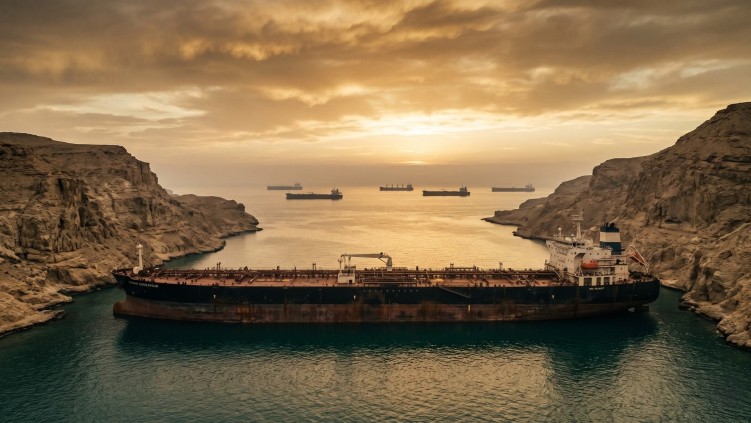
The Touska was seized yesterday. Hormuz has been closed since Friday. The ceasefire expires tomorrow. The inflation clock that briefly paused in April has restarted, and this time the Fed has no room to respond.
The Big Story: The 48-Hour Wall
The Strait of Hormuz has been shut since 18 April, when Iran's IRGC declared it closed for the second time since the conflict began. On 19 April, the USS Spruance fired on the engine room of an Iranian cargo vessel, the Touska, in the Gulf of Oman and seized it. No tankers passed through Hormuz on Sunday — one of the quietest days the strait has seen. The US military forced 23 ships to turn around.
The ceasefire expires tomorrow, 21 April. An Iranian delegation is expected in Pakistan on Tuesday, but Tehran has stated it will not attend those talks while the blockade continues. The blockade is active, the ceasefire is gone at midnight, and the diplomatic channel is functionally closed.
Brent crude closed at $95.59 on 19 April, up 5.8% on the day of the seizure. Goldman's $147 scenario requires three conditions: Hormuz closure, the US blockade, and a breakdown in talks. All three are now active simultaneously. The next material oil move has one direction.
This matters for every expat in Southeast Asia earning in a pegged or weakened currency. March CPI (the consumer prices index — how much more everyday goods cost compared to a year ago) came in at 3.3% year-on-year, up from 2.4% in February, driven by a 12.5% surge in energy prices. The US central bank meets on 28-29 April. Prediction markets are pricing a 99.3% probability of no change to interest rates. Goldman has already pushed its first rate cut call to September. If oil breaks above $100 before that meeting, the consensus of even one cut this year will move to zero.
A French professional in Singapore earning in EUR, a Spanish engineer in Abu Dhabi paid in USD, a German executive in Bangkok spending in THB: each is running a currency exposure into a period of rising energy costs, a frozen central bank, and a supply corridor that has been physically interrupted twice in six weeks. The inflation they thought had peaked is repricing around them.
What Else Is Moving
Singapore tightened monetary policy as its economy contracted. On 14 April, the Monetary Authority of Singapore steepened the slope of its exchange rate policy, raising its core inflation forecast to 1.5–2.5% from 1–2%. The decision came alongside Singapore's Q1 GDP reading of -0.3%, the city-state's first quarterly contraction since the pandemic. MAS chose inflation control over growth support. SGD remains stable and resilient, but the policy mix — tighter monetary conditions into a contracting economy — signals that Singapore's central bank sees the energy price surge as the more immediate threat.
Bank Negara holds as the ringgit finds support. USD/MYR sits at approximately 3.95, at the stronger end of its 12-month range. The World Bank raised Malaysia's GDP growth forecast to 4.4% this week, and foreign capital continues flowing into Malaysian bonds. Malaysia's status as a net oil exporter provides a tailwind when Brent sustains above $95. The counter-pressure is risk-off capital flight from the Touska seizure and strait closure, which may offset the net-exporter gain if the conflict escalates further.
UK stagflation arriving on both fronts. UK CPI came in above forecast this week, and the Bank of England faces the same trap as the US central bank: energy-driven inflation that cannot be addressed with demand-side tools while growth is already under pressure. The April 2026 UK tax changes are compounding this for British expats. The removal of the non-resident dividend tax credit, the CGT rise on Business Asset Disposal Relief to 18%, and new digital tax filing requirements for landlords with receipts above £50,000 all went live on 6 April. British nationals with UK rental portfolios or pending business disposals now face a worse tax position and a weaker home-currency environment simultaneously.
Gold pulled back despite escalation. Spot gold closed at approximately $4,784 on 19 April, down 1.02% on the day of the Touska seizure and Hormuz closure. The geopolitical bid has not fully reasserted, possibly reflecting dollar strength or profit-taking after gold's 26–29% gain so far this year. The structural case is unchanged: J.P. Morgan holds a $6,300 year-end target, Goldman $5,400. If the ceasefire expires tomorrow without renewal and Tuesday's talks do not start, gold's next move is up. At EUR/USD 1.178, gold sits at approximately EUR 4,060 per troy ounce for continental European holders.
The Expat Takeaway
A lot moved this week, and more will move in the next 48 hours. The ceasefire expiry and Tuesday's talks are a genuine inflection point — not because one news event changes a long-term portfolio, but because the conditions that were supposed to ease (energy prices, the rate path, inflation) have been reset in the wrong direction.
The portfolios that absorb this week without structural damage were not built this week.
Three questions worth sitting with before Tuesday's talks. Is your liquid buffer held in the currency you actually spend, not just the one you earn in? If you earn in SAR or USD and spend in THB or SGD, the buffer calculation needs to account for where the money lands, not where it originates. Is your equity allocation weighted toward markets genuinely uncorrelated with an oil shock, or have you drifted into energy-adjacent concentration without checking? And is your time horizon confirmed in writing, with your own numbers, and longer than the cycle that made you open your portfolio today?
If your structure holds under all three, this is a week to watch. If something does not hold, the issue was in place long before the Touska was seized.
Until next week.
Cip | Bratu Capital
Managing wealth for globally mobile professionals across Southeast Asia.